|
Size: 1162
Comment:
|
Size: 1165
Comment:
|
| Deletions are marked like this. | Additions are marked like this. |
| Line 21: | Line 21: |
| P_t\,C_t &= W_t\, L_t\\ P_t &= (1+\pi_t) P_{t-1}\\ r_t &= \rho_1 (\pi_t - \bar \pi) |
P_t\,C_t &=& W_t\, L_t\\ P_t &=& (1+\pi_t) P_{t-1}\\ r_t &=& \rho_1 (\pi_t - \bar \pi) |
Automatic removing of trends
Stationarizing a non-linear model by hand is a tedious process that is better done by the computer.
Computing the equilibrium growth rates of a balanced growth model is complicated and will not be attempted here. We limit ourselves to replace non-stationary variables by their stationary counterpart as specified by the user.
First case: exogenous nonstationary process
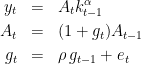
Assuming that  and
and  have common trend
  , the stationarizing procedure calls for dividing first and second equation by . The second equation becomes meaningless and corresponds to the fact that doesn't belong to the stationary model.
Second case: endogenous nonstationary process
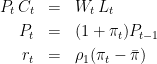
In this case as well, the second equation becomes meaningless after stationarizing the model.